
German Red Cross Committee on International Humanitarian Law
Mandate and Legal basis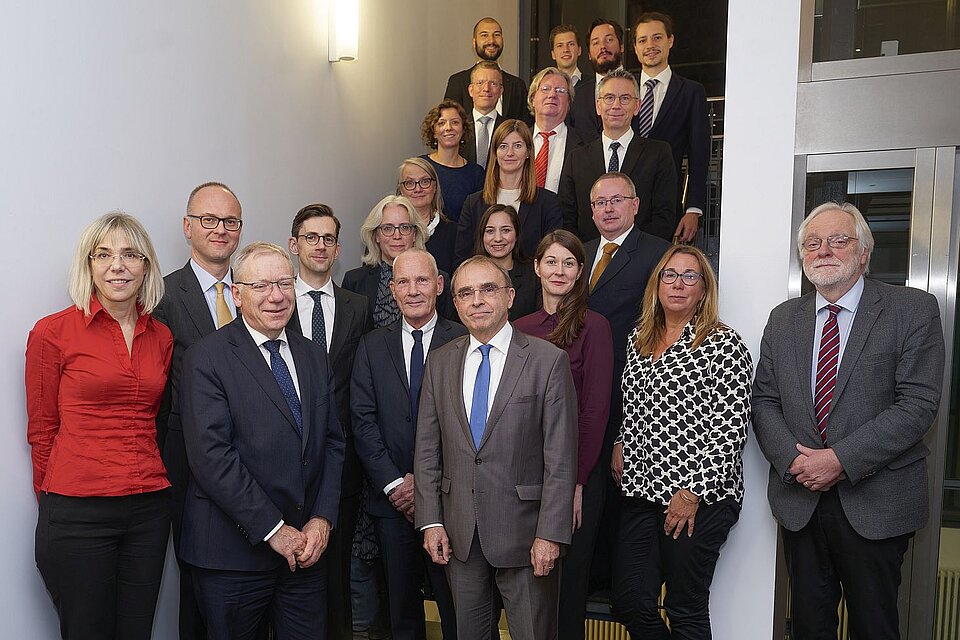
The Technical Committee “International Humanitarian Law” / the German Committee on International Humanitarian Law fulfils a dual function as an advisory body to the Presidential Board of the German Red Cross and as an advisory body to the German Federal Government on matters of international humanitarian law. The Committee was established in 1973. Its legal basis is derived from Sections 13 VIII, 22 I and 22 VIII of the Statutes of the German Red Cross. By letter from the Permanent Mission of Germany in Geneva to the International Committee of the Red Cross (ICRC), the Committee was designated in 1996 as Germany’s National IHL Committee.
As the German Committee on IHL, its objective is to provide a platform for discussion and coordination between the German Red Cross, academia and the various ministries of the German Federal Government. The Committee’s substantive priorities include issues relating to the implementation of international humanitarian law into the German legal and administrative system, the dissemination of international humanitarian law and its further development. In its deliberations, the Committee addresses current issues of international law, issues recommendations, contributes to the development of conference resolutions and international treaties, and, through its discussions, generally contributes to the formulation of positions of the German Federal Government on matters of international humanitarian law.
Work of the Committee
The German Committee on International Humanitarian Law continuously publishes the Report on the Implementation of International Humanitarian Law in the Federal Republic of Germany. Further information is provided below. In addition, particular mention should be made of the active role the Committee played in relation to the development of the 1977 Additional Protocols to the Geneva Conventions and their ratification by Germany.
The issue of the use of cluster munitions and the German initiative concerning an international treaty on cluster munitions were also discussed in detail within the Committee. In this context, members of the German Red Cross and the Federal Government agreed that such a treaty should also include provisions on victim assistance. Moreover, the Federal Government took up a request by the German Red Cross and advocated at the international level for the problem of the potentially indiscriminate effects of cluster munitions also to be addressed. The Convention on Cluster Munitions, which was ultimately adopted in 2008 and includes, among other things, these two aspects, also reflects the importance of the exchange within the Committee.
The Committee has also made a decisive contribution in the field of international criminal law by participating both in the establishment of the International Criminal Court and in the national implementation of international criminal law. In particular, questions relating to the Statute of the International Criminal Court, such as the Elements of Crimes, were discussed in depth within the Committee, which was also involved in the drafting of the German Code of Crimes against International Law.
A current example of the Committee’s work is the “Global Initiative to Galvanize Political Commitment to International Humanitarian Law”, launched in 2024 by the International Committee of the Red Cross together with Brazil, China, France, Jordan, Kazakhstan and South Africa. The aim of the initiative is to strengthen political commitment to international humanitarian law and to develop concrete recommendations to improve compliance with it. Across a total of seven workstreams, the initiative addresses both structural issues, including prevention, National IHL Committees and the relationship between international humanitarian law and peace, as well as topics of current relevance, such as the protection of civilian infrastructure, the protection of medical facilities, information and communication technologies, and naval warfare.
Together with Peru, the Philippines and the United Kingdom, the Federal Republic of Germany has assumed responsibility as Co-Chair for the workstream dealing with the role of National Committees on International Humanitarian Law and examining how these committees can be further strengthened with a view to the implementation, operationalization and dissemination of international humanitarian law.
The Committee consists of representatives of the federal ministries dealing with international humanitarian law, representatives of the Federal Public Prosecutor General at the Federal Court of Justice, members of the academic community in the field of international law, and staff members of the International Relations and International Humanitarian Law Unit at the Headquarters of the German Red Cross.
Implementation of International Humanitarian Law in Germany
Contact
GRC Committee on International Humanitarian Law / German Committee on International Humanitarian Law
c/o German Red Cross e.V. – Headquarters
International Relations and International Humanitarian Law-Unit
Carstennstraße 58
12205 Berlin
Head of Unit
Dr. Katja Schöberl
Phone: +49 (0) 30 85404 805
E-Mail: k.schoeberl(at)drk(dot)de
Legal Adviser, International Law
Jakob Forini, LL.M.
Phone: +49 (0) 30 85404 368
E-Mail: fachausschuss(at)drk(dot)de